My essay, Practice Makes Perfect, appears in Chicken Soup for the Soul: The Joy of Less.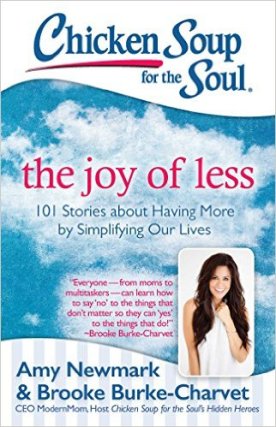
Over the last few years, I’ve made a concerted effort to get rid of clutter. It actually started as a spiritual practice. I had asked God to make things more obvious to me as I was having a hard time making decisions, artistically.
My prayers were answered. At the same time, however, I (suddenly?) noticed that my house had become cluttered. Like so many of us, I had accumulated too much and thrown out too little. Yet, for some reason, it had never bothered me before.
This new sensation was a strong, compelling force and I felt the weight of every item in my house. I wanted to see actual space, not clutter and “pitch it” became my motto.
I spent a year giving things away and selling things on e-Bay and Etsy. It was an arduous task, but gratifying and educational. I learned how to sell online and became a semi-knowledgeable seller of rare books (having to research first editions I’d picked up at yard sales before placing them on Etsy).
What became very clear to me, importantly, was how it had changed my thought process.
It seemed that less clutter in the house created less clutter in my mind. I was able to make better decisions.
Anyway, my story has nothing to do with material items. It has to do with activities. As I mentioned, when I de-cluttered my house, I felt compelled to de-clutter other things in my life. One of them happened to be my son’s activities.
Parents are notorious for cramming kids’ schedules with too many activities (some of you are nodding). It’s not healthy for them….or for us. I mean, who can excel at everything?
I’ll just leave it there as I’ll be writing more about de-cluttering in the next few months as I read through the book (it’s due out in April).
Here’s my advice for now:
De-clutter your house. De-clutter your mind. De-clutter your schedule.
And remember, there is joy in the space. Because, less is truly more.






 Mary C. M. Phillips