Feeds:
Posts
Comments

Whartonmeme


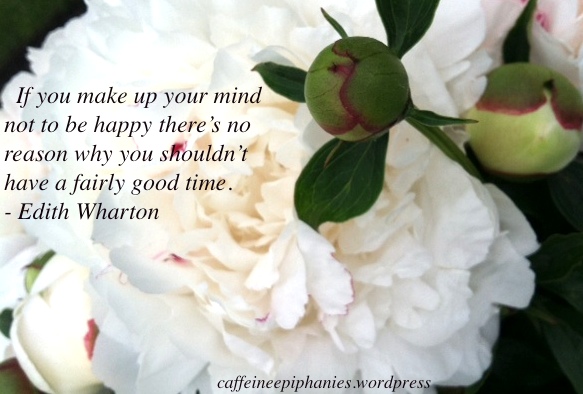
Although the quote “If only we’d stop trying to be happy, we’d all have a pretty good time” has been attributed to Edith Wharton, the words are not entirely accurate.   In her short story, The Last Asset, written in 1904, one of the characters states, “Possibilities of what? Of being multifariously miserable? There are lots of ways of being miserable, but there’s only one way of being comfortable, and that is to stop running round after happiness. If you make up your mind not to be happy there’s no reason why you shouldn’t have a fairly good time.”

So ironic, but so true.  If I take my mind off of myself and get myself out of the way (my expectations, my ego, my ambitions), I have a better shot at being happy….or rather content.  There’s a difference.  I’ve found that happiness is very short lived and relies on the situation — the stuff that’s out of our control.

Contentment is the goal, not happiness.

And from my own experience, contentment is found in living in the moment, seeing what’s before me — right in front of me — and reacting with compassion.  Living in the here and now, presently.  There I can sense an inner peace that leads to contentment.  I slow down and smell the roses or the coffee or whatever’s in the air that particular moment.

Edith Wharton’s words, make up your mind not to be happy, for some strange reason make me smile.  More irony!  So, there must be a grain of truth in there somewhere.


tulips

Pupils and teachers sat neatly arrayed, orderly, and expectant, each bearing in her hand the bouquet of felicitation– the prettiest spring-flowers all fresh, and filling the air with their fragrance:  I only had no bouquet.  I like to see flowers growing, but when they are gathered, they cease to please.  I look on them as things rootless and perishable; their likeness to life makes me sad.  I never offer flowers to those I love; I never wish to receive them from hands dear to me.    

– Charlotte Brontë, Villette  


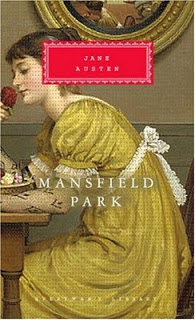
The celebration of the 200th anniversary of the publication of Mansfield Park starts today at SarahEmsley.com.

Sarah Emsley's avatarSarah Emsley

Happy 200th anniversary to Mansfield Park , published on this day in 1814. Mansfield Park is not as famous as Jane Austen’s “darling child”  Pride and Prejudice,  but it’s still beloved, and the celebrations are just beginning. Please join us here every Friday this year as we read the novel together – open “Your Invitation to Mansfield Park for more details.

An Invitation to Mansfield Park

I’m very happy to introduce Lyn Bennett’s guest post on the opening paragraph of Mansfield Park. Lyn is an Associate Professor at Dalhousie University, where she teaches classes in rhetoric, writing, and close reading. As well as Women Writing of Divinest Things (Pittsburgh: Duquesne University Press, 2004), she has published numerous articles on topics rhetorical and literary, from public discourse in Interregnum England, to interdisciplinarity in literary studies, to the critical reception of Edith Wharton. (Hooray for Edith Wharton!) Her current research focuses on medicine, illness, and the 17th-century writer…

View original post 1,562 more words


Moon-1885 by Ivan Aivazovsky

Moon-1885 by Ivan Aivazovsky

Charlotte Brontë ‘s description in Villette is nothing short of mesmerizing.

Here, Lucy Snowe is making her way through a park in which a concert (a “fête”) had been held.   The crowd is thinning and the festivities are over.  Only the majesty of the moon remains.

High she rode, and calm and stainlessly she shone.  The music and the mirth of the fête, the fire and bright hues of those lamps had out-done and out-shone her for an hour, but now, again, her glory and her silence triumphed.  The rival lamps were dying:  she held her course like a white fate.  Drum, trumpet, bugle, had uttered their clangour and were forgotten:  with pencil-ray she wrote on heaven and on earth records for archives everlasting.  She and those stars seemed to me at once the types and witnesses of truth all regnant.  The night-sky lit her reign:  like its slow-wheeling progress, advanced her victory-that onward movement which has been, and is, and will be from eternity to eternity.