Feeds:
Posts
Comments

As summer moves along, I find my days to be quiet and uneventful or busy and hectic.

I also notice that while I’m in the midst of one, I’m longing for the other.41ym0nvL8oL._SY344_BO1,204,203,200_

I suppose I’m just trying to find (like all of us) that perfect balance between solitude and social activity. It’s not easy.

Over the last month, I’ve been working on a project that requires a bit of research. One of the books I’ve chosen to draw from is Cecilia by Frances Burney.

It’s not a quick read by any means.

The title of Jane Austen’s Pride and Prejudice was in all likelihood taken from the final chapter of Cecilia in which it reads: 

The whole of this unfortunate business,” said Dr. Lyster, “has been the result of PRIDE AND PREJUDICE… 

…Yet this, however, remember; if to PRIDE and PREJUDICE you owe your miseries, so wonderfully is good and evil balanced, that to PRIDE and PREJUDICE you will also owe their termination…

So while reading this rather long book — and while longing for that perfect balance between solitude and social activity — I was pleasantly surprised to find Cecilia herself sharing in my dilemma.

Of course, her social activity is somewhat different than my own…but I can relate.

And relating is good!

Let’s face it…it’s hard to be an introvert.

And thus, in acts of goodness and charity, passed undisturbed another week of the life of Cecilia:  but when the fervor of self-approbation lost its novelty, the pleasure with which her new plan was begun first subsided into tranquility, and then sunk into languor. To a heart formed for friendship and affection the charms of solitude are very short lived:  and though she had sickened of the turbulence of perpetual company, she now wearied of passing all her time by herself, and sighed for the comfort of society, and the relief of communication. But she saw with astonishment the difficulty with which this was to be obtained:  the endless succession of diversions, the continual rotation of assemblies, the numerousness of splendid engagements, of which while everyone complained, every one was proud to boast, so effectually impeded private meetings and friendly intercourse, that, which ever way she turned herself, all commerce seemed impracticable, but such as either led to dissipation, or accidentally flowed from it.  

I’m only half way through the book, but I’m always happy to find a character that is not only believable but relatable.

Hope everyone is enjoying their summer!


I’m writing over at The Dark Jane Austen Book Club about little dogs and The Ghost Stories of Edith Wharton.

ENTER if you dare…

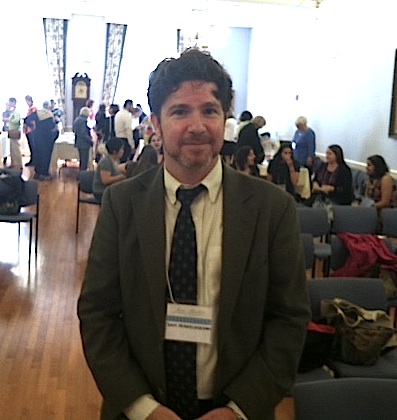
On a beautiful June afternoon in New York City, Janeites gathered to attend Daniel R. Mangiavellano’s program, “I just flew in from Pemberley (and boy, are my arms tired!)”:  Rethinking Darcy’s Humor in PRIDE AND PREJUDICE (hosted by JASNA-NY). 

Needless to say, it was most agreeable.

Daniel R. Mangiavellano, Assistant Professor of English at Loyola University Maryland

Daniel R. Mangiavellano, Assistant Professor of English at Loyola University Maryland

In Chapter 11 of Pride and Prejudice, we read, “Mr. Darcy is not to be laughed at!’ cried Elizabeth. ‘That is an uncommon advantage, and uncommon I hope it will continue, for it would be a great loss to me to have many such acquaintance. I dearly love a laugh.”  

So do I.

But why can’t we laugh at Mr. Darcy?  Is he too superior to engage in laughter? Perhaps.

Professor Mangiavellano pointed out that according to the 4th Earl of Chesterfield, laughing was no laughing matter.

In the book, Letters to His Son on the Art of Becoming a Man of the World and a Gentleman, Chesterfield urges his son to refrain from the act of laughter. Chesterfield was an aristocrat, a member of Parliament, and a snob. His letters were never meant to be made public. They were written in 1748 and later published by the impoverished widow of his illegitimate son in 1774.

Chesterfield writes, I would heartily wish that you may often be seen to smile, but never heard to laugh, while you live. Frequent and loud laughter is the characteristic of folly and ill-manners; it is the manner in which the mob express their silly joy at silly things; and they call it ‘being merry’. In my mind, there is nothing so illiberal, and so ill-bred, as audible laughter. I am neither of a melancholy nor a cynical disposition, and am as willing and as apt to be pleased as anybody; but I am sure that since I have had the full use of my reason nobody has ever heard me laugh.

Was Austen making fun of Chesterfield in the stoic character of Mr. Darcy?

Mangiavellano reminded us that with Rev. George Austen’s extensive home library, it’s likely that Jane had access to Chesterfield’s book. She was an avid reader as we know.

The way in which Austen takes jabs at society (or The Church of England or authors that frown upon novels or even perhaps Chesterfield) is brilliantly subtle. I believe it’s one of the reasons that readers return to her books, reading them over and over again. Subtle humor is always fresh.

This was only one of the many observations made during last week’s wonderful discussion on Mr. Darcy’s humor.

Despite the lack of laughter on Darcy’s part, JASNA-NY members delightfully submitted to the act, thoroughly enjoying the program and the presenter’s new insight on Mr. Darcy. Mr. Darcy, proud as he may be, exhibits humor in his own special — and positively Austen — way.

The program was followed by conversation and refreshments and sponsored by JASNA-NY.

water color: caroline zimmerman

water color: caroline zimmerman