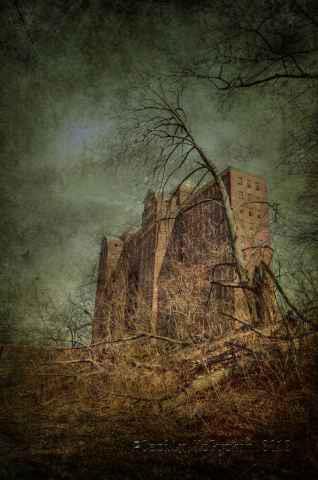
A monster, a zombie, or a silent house? Which is the scariest?

Photo by Cecily McGuckin
The last…according to Edith Wharton.
And she’s not the only writer (or artist) of that opinion.
I remember reading an interview with Sir Anthony Hopkins years ago. He was asked about his portrayal of the character Hannibal Lecter in The Silence of the Lambs. How did he go about playing the role of such a frightening character?
Mastering the art of stillness.
That was the key. I remember him saying that the combination of his physical stillness — along with the activity that went on behind his eyes — was what made the character so frightening. Remember him standing perfectly still in that prison cell?
The Ghost Stories of Edith Wharton, a collection of short creepy stories, uses the same approach. No blood. No fangs. No outright monsters. Just layers of silence, stillness, confusion, and doubt. Unsettling stuff, indeed.
The last story in the book, All Souls’, is told by a narrator. It’s a story about a cousin who has fractured her ankle and must remain in bed until the doctor returns on Monday. That night, as a snowstorm hits, she struggles to remain calm within a large house in a remote countryside. In the early hours of morning, she is in agonizing pain. She calls her servants. No one answers; the phone has been disconnected. She’s forced to crawl through the large empty house looking for life. Where has her trusty maid gone? Where is the butler? Poor Mrs. Clayburn. Snowbound with a broken leg à la James Caan in Misery
Silence. Only silence.
More and more the cold unanswering silence of the house weighted down on Mrs. Clayburn. She had never thought of it as a big house, but now, in this snowy winter light, it seemed immense, and full of ominous corners around which one dared not look…More than once she had explored the ground floor alone in the small hours, in search of unwonted midnight noises; but now it was not the idea of noises that frightened her, but that inexorable and hostile silence, the sense that the house had retained in full daylight its nocturnal mystery, and was watching her as she was watching it…