Feeds:
Posts
Comments

Archive for the ‘Uncategorized’ Category

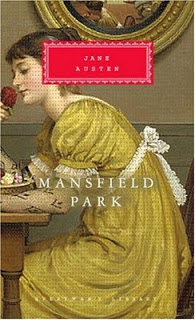
Today, I’m writing over at Sarah Emsley’s blog about Mary Crawrford, Fanny Price, and random acts of kindness.  Mansfield Park

Please join us as we celebrate 200 years of Jane Austen’s Mansfield Park!
Read more…


Sarah Emsley's avatarSarah Emsley

Sixth in a series of posts celebrating 200 years of Jane Austen’s Mansfield Park. For more details, open Your Invitation to Mansfield Park.

Mary C.M. Phillips writes about works by her favourite authors, Jane Austen and Edith Wharton, at Caffeine Epiphanies, and she recently co-hosted a discussion of Wharton’s life and works – including my own favourite, The Custom of the Country – at the Malverne Public Library in Malverne, New York. Her short stories and essays have appeared in numerous anthologies, such as Chicken Soup for the Soul, A Cup of Comfort, and Bad Austen: The Worst Stories Jane Never Wrote. Follow her on Twitter @MarycmPhil. I met Mary at the 2012 JASNA AGM in New York and have enjoyed many conversations with her about both Austen and Wharton since then. I’m very happy to introduce her guest post on Mary Crawford’s famous…

View original post 906 more words
Read Full Post »

Whartonmeme


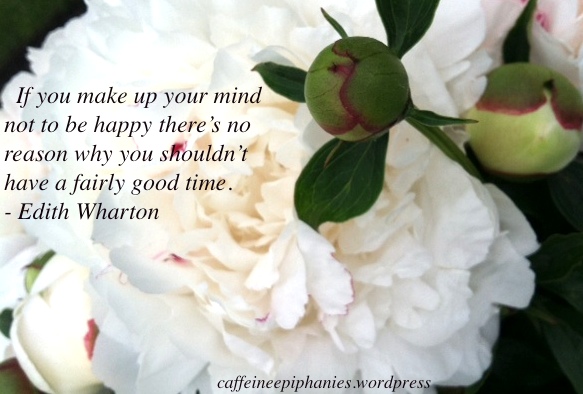
Although the quote “If only we’d stop trying to be happy, we’d all have a pretty good time” has been attributed to Edith Wharton, the words are not entirely accurate.   In her short story, The Last Asset, written in 1904, one of the characters states, “Possibilities of what? Of being multifariously miserable? There are lots of ways of being miserable, but there’s only one way of being comfortable, and that is to stop running round after happiness. If you make up your mind not to be happy there’s no reason why you shouldn’t have a fairly good time.”

So ironic, but so true.  If I take my mind off of myself and get myself out of the way (my expectations, my ego, my ambitions), I have a better shot at being happy….or rather content.  There’s a difference.  I’ve found that happiness is very short lived and relies on the situation — the stuff that’s out of our control.

Contentment is the goal, not happiness.

And from my own experience, contentment is found in living in the moment, seeing what’s before me — right in front of me — and reacting with compassion.  Living in the here and now, presently.  There I can sense an inner peace that leads to contentment.  I slow down and smell the roses or the coffee or whatever’s in the air that particular moment.

Edith Wharton’s words, make up your mind not to be happy, for some strange reason make me smile.  More irony!  So, there must be a grain of truth in there somewhere.


Read Full Post »


tulips

Pupils and teachers sat neatly arrayed, orderly, and expectant, each bearing in her hand the bouquet of felicitation– the prettiest spring-flowers all fresh, and filling the air with their fragrance:  I only had no bouquet.  I like to see flowers growing, but when they are gathered, they cease to please.  I look on them as things rootless and perishable; their likeness to life makes me sad.  I never offer flowers to those I love; I never wish to receive them from hands dear to me.    

– Charlotte Brontë, Villette  


Read Full Post »

The celebration of the 200th anniversary of the publication of Mansfield Park starts today at SarahEmsley.com.

Sarah Emsley's avatarSarah Emsley

Happy 200th anniversary to Mansfield Park , published on this day in 1814. Mansfield Park is not as famous as Jane Austen’s “darling child”  Pride and Prejudice,  but it’s still beloved, and the celebrations are just beginning. Please join us here every Friday this year as we read the novel together – open “Your Invitation to Mansfield Park for more details.

An Invitation to Mansfield Park

I’m very happy to introduce Lyn Bennett’s guest post on the opening paragraph of Mansfield Park. Lyn is an Associate Professor at Dalhousie University, where she teaches classes in rhetoric, writing, and close reading. As well as Women Writing of Divinest Things (Pittsburgh: Duquesne University Press, 2004), she has published numerous articles on topics rhetorical and literary, from public discourse in Interregnum England, to interdisciplinarity in literary studies, to the critical reception of Edith Wharton. (Hooray for Edith Wharton!) Her current research focuses on medicine, illness, and the 17th-century writer…

View original post 1,562 more words

Read Full Post »

« Newer Posts - Older Posts »