I’m writing over at The Dark Jane Austen Book Club about little dogs and The Ghost Stories of Edith Wharton.
Archive for the ‘Uncategorized’ Category
Wharton’s Kerfol
Posted in Uncategorized on June 25, 2015| Leave a Comment »
Mr. Darcy is “No Laughing” Matter
Posted in Uncategorized on June 9, 2015| Leave a Comment »
On a beautiful June afternoon in New York City, Janeites gathered to attend Daniel R. Mangiavellano’s program, “I just flew in from Pemberley (and boy, are my arms tired!)”: Rethinking Darcy’s Humor in PRIDE AND PREJUDICE (hosted by JASNA-NY).
Needless to say, it was most agreeable.
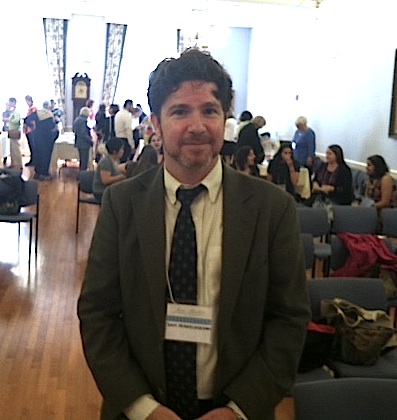
Daniel R. Mangiavellano, Assistant Professor of English at Loyola University Maryland
In Chapter 11 of Pride and Prejudice, we read, “Mr. Darcy is not to be laughed at!’ cried Elizabeth. ‘That is an uncommon advantage, and uncommon I hope it will continue, for it would be a great loss to me to have many such acquaintance. I dearly love a laugh.”
So do I.
But why can’t we laugh at Mr. Darcy? Is he too superior to engage in laughter? Perhaps.
Professor Mangiavellano pointed out that according to the 4th Earl of Chesterfield, laughing was no laughing matter.
In the book, Letters to His Son on the Art of Becoming a Man of the World and a Gentleman, Chesterfield urges his son to refrain from the act of laughter. Chesterfield was an aristocrat, a member of Parliament, and a snob. His letters were never meant to be made public. They were written in 1748 and later published by the impoverished widow of his illegitimate son in 1774.
Chesterfield writes, I would heartily wish that you may often be seen to smile, but never heard to laugh, while you live. Frequent and loud laughter is the characteristic of folly and ill-manners; it is the manner in which the mob express their silly joy at silly things; and they call it ‘being merry’. In my mind, there is nothing so illiberal, and so ill-bred, as audible laughter. I am neither of a melancholy nor a cynical disposition, and am as willing and as apt to be pleased as anybody; but I am sure that since I have had the full use of my reason nobody has ever heard me laugh.
Was Austen making fun of Chesterfield in the stoic character of Mr. Darcy?
Mangiavellano reminded us that with Rev. George Austen’s extensive home library, it’s likely that Jane had access to Chesterfield’s book. She was an avid reader as we know.
The way in which Austen takes jabs at society (or The Church of England or authors that frown upon novels or even perhaps Chesterfield) is brilliantly subtle. I believe it’s one of the reasons that readers return to her books, reading them over and over again. Subtle humor is always fresh.
This was only one of the many observations made during last week’s wonderful discussion on Mr. Darcy’s humor.
Despite the lack of laughter on Darcy’s part, JASNA-NY members delightfully submitted to the act, thoroughly enjoying the program and the presenter’s new insight on Mr. Darcy. Mr. Darcy, proud as he may be, exhibits humor in his own special — and positively Austen — way.
The program was followed by conversation and refreshments and sponsored by JASNA-NY.
Happy Birthday Ralph Waldo Emerson
Posted in Uncategorized on May 25, 2015| 2 Comments »
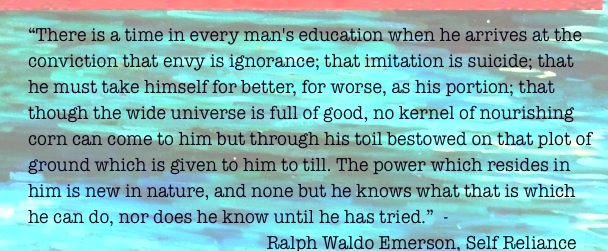
water color: caroline zimmerman
May I? — A Poem on War, Unrest, and a Centenary of Change
Posted in Uncategorized on May 3, 2015| Leave a Comment »
“May is not always just a month of change, it is a month of reflection, revival, and growth.”

May is not always just a month of change, it is a month of reflection, revival, and growth.
Not just in seasonal and allegorical ways, either, but in historical, individual ways.
On May 1, 1915, the RMS Lusitania set out from her American port en route to Liverpool. She was a ship of wonder, the equivalent of The White Star Line’s Titanic, famously lost three years earlier, a rival of the Cunard line’s crowning glory, and icon of Edwardian engineering and maritime pride.
She never made it back home through the ‘war zones’ of Britain, and fell in spectacle on May 7, 1915, to the bottom of the sea, seven miles off the southern coast of Ireland, in vantage point from the lighthouse that caps the cliff of ‘The Old Head of Kinsale’; with 1,198 souls lost, many of them Americans, the murder of the Lusitania outraged the American…
View original post 548 more words
Mary C. M. Phillips – About

- Follow Mary C. M. Phillips on WordPress.com
-
Music of the Forest

Mary C. M. Phillips


Contributing writer for Chicken Soup for the Soul. Visit CSS to see the good work they’re doing - and be inspired with an encouraging word. -

-
Some links I like:
-
Jane Austen - Backstories (blog)

 Mary C. M. Phillips